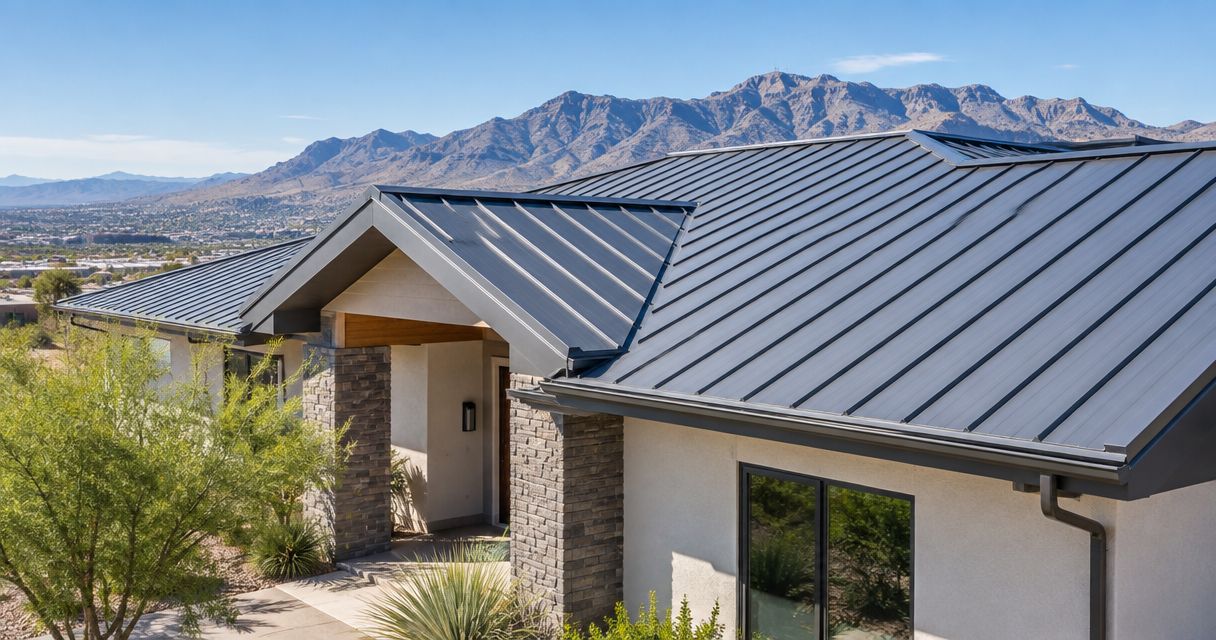
Best overall: standing seam for concealed fastening. Best for a straightforward exposed-fastener roof: R-Panel. Best for a traditional ribbed appearance: corrugated metal panels. This 2026 guide compares metal roofing panels for El Paso homes by fastening method, roof compatibility, appearance, and maintenance requirements.
- For best metal roofing panels El Paso comparisons, standing seam is the default when concealed fastening matters most.
- R-Panel suits homeowners choosing an exposed-fastener metal roof with a pronounced rib profile.
- Corrugated metal panels suit homeowners who specifically want a traditional repeating-wave appearance.
- Sunnyboy Roofing offers standing seam and R-Panel installation in El Paso; compare the complete roof specification before choosing.
Why this matters
A metal roof is an assembly, not just a sheet of steel. Panels, seams, fasteners, underlayment, flashing, and the roof deck must work together. A panel profile alone does not establish whether the finished roof suits your home.
Sunnyboy Roofing is a licensed and insured El Paso contractor offering metal roofing installation, repairs, and replacements. Sunnyboy Roofing is a fit for El Paso homeowners comparing standing seam and R-Panel installation.
For your 2026 project, compare 3 panel types, understand 2 fastening approaches, and require 1 written roof specification before approving the work. Those checks keep the decision focused on the installed system rather than a sample panel or a material name.
What makes the best metal roofing panels
Use these criteria before comparing proposals. The strongest choice is the panel system that fits your roof and your maintenance expectations—not the one with the longest feature list.
- Fastening method: Concealed-fastener systems keep attachment points beneath the panel assembly. Exposed-fastener systems use visible screws through the panels.
- Roof compatibility: Confirm that the specific panel system is approved for your roof slope, deck, and installation method. Requirements differ between products within the same category.
- Water-management details: Look for specified seams, end laps where applicable, valley details, and flashing around roof penetrations. A panel name does not explain these details.
- Movement accommodation: Metal expands and contracts as its temperature changes. Attachment and seam details must accommodate that movement according to the system instructions.
- Finish and appearance: Compare the actual profile, finish documentation, and samples. A painted metal panel is not automatically a cool-roof product.
- Inspection access: Understand which seams, screws, sealants, and flashings require inspection. Choose a system whose maintenance needs you are prepared to address.
Ask the contractor to connect each criterion to your house. A proposal that merely says metal roofing leaves important choices unresolved, including which panel, fastening method, and flashing details will be installed.
Metal roofing panels at a glance
These are panel categories, not interchangeable products. The ranking below separates distinct homeowner priorities; it does not assign unsupported performance scores to unnamed manufacturers.
| Panel type | Best for | Standout feature | Key limitation |
|---|---|---|---|
| Standing seam | Concealed fastening | Raised seams with attachment concealed within the system | Seam design and installation requirements vary by product |
| R-Panel | A straightforward exposed-fastener assembly | Pronounced ribs with visible screw attachment in exposed-fastener installations | Exposed fasteners and sealing washers require inspection |
| Corrugated metal panels | A traditional repeating-wave appearance | Rounded, repeating corrugations | Roofing suitability, laps, and fastening details require product-specific verification |
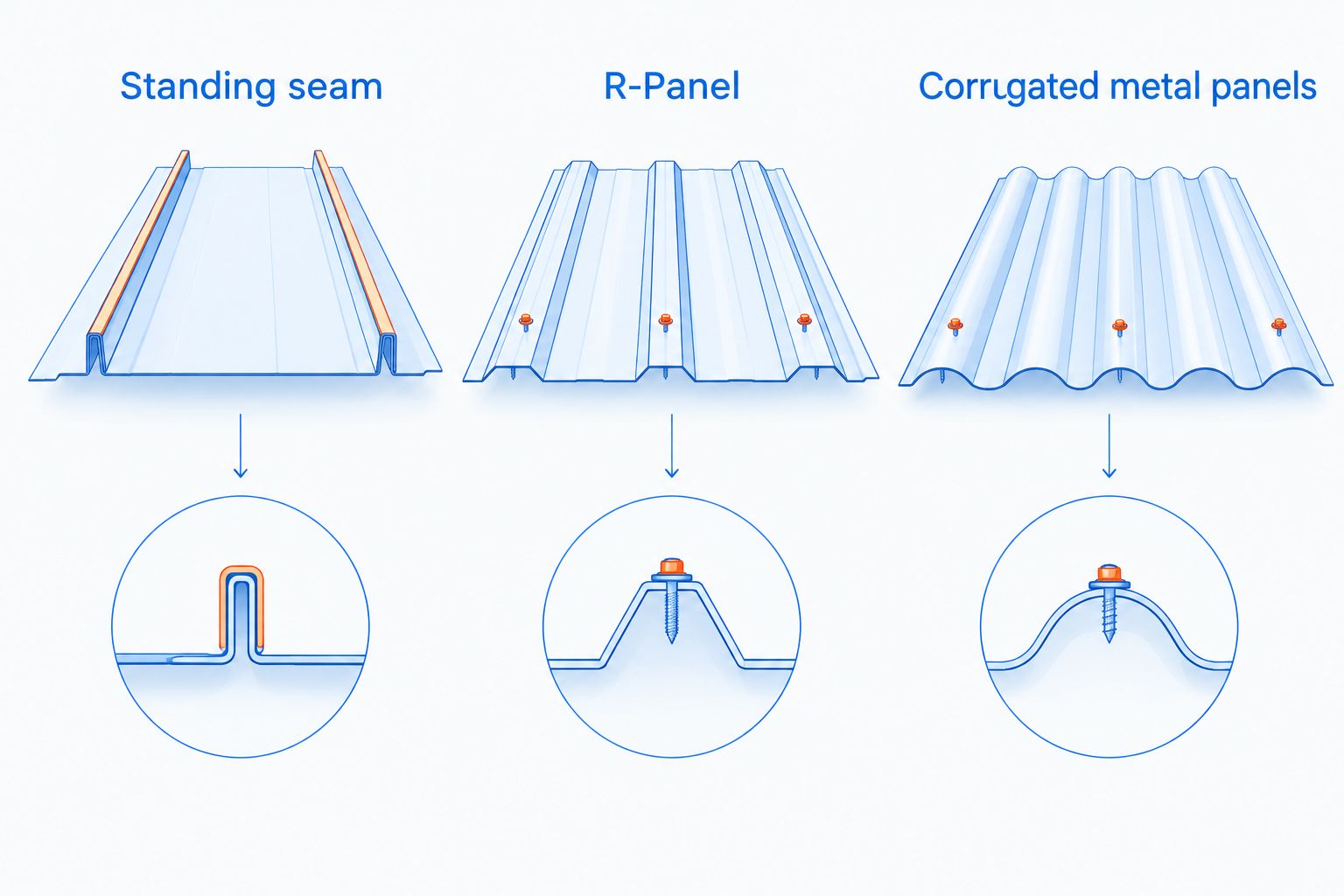
The main distinction is not simply standing seam versus corrugated appearance. It is whether the assembly conceals its attachment points or relies on exposed penetrations through the panel surface.
1. Standing seam: best metal roofing panels for concealed fastening
Standing seam roofing uses panels joined along raised seams. In concealed-fastener assemblies, attachment points sit beneath or within the panel system rather than remaining exposed across the roof surface. Depending on the product, seams snap together or require mechanical seaming.
Standing seam is the default recommendation when concealed fastening is your main priority. That recommendation does not mean every standing seam product fits every roof. The exact seam design and manufacturer instructions determine the permitted installation.
Standing seam pros
- Concealed attachment avoids exposed screw heads across the main panel surface.
- Raised seams create a defined panel-to-panel connection.
- Long, straight seam lines suit homeowners who want a linear roof appearance.
- Product-specific attachment details can accommodate thermal movement.
Standing seam cons
- Different seam types have different installation and roof-slope requirements.
- Incorrect clips, attachment, or seaming can compromise the intended assembly.
- Broad metal surfaces can show oil canning, a visible waviness that should be discussed before installation.
Oil canning is an appearance issue, not automatic evidence of a leak. Ask how panel width, substrate conditions, handling, and installation affect the finished appearance. Review a sample without treating it as a guarantee that the entire roof will look perfectly flat.
For a 2026 standing seam proposal, request the panel manufacturer, profile, seam type, attachment method, and applicable installation instructions. Also ask how valleys, chimneys, vents, and wall intersections will be flashed. These details explain the roof more clearly than the words standing seam alone.
Sunnyboy Roofing offers standing seam installation. Keep the conversation centered on the proposed assembly and your existing roof, rather than assuming the service name establishes a particular gauge, finish, or warranty.
Best for: Homeowners who prioritize concealed fastening and a linear panel appearance.
Verdict: Buy standing seam when the specified system fits your roof and concealed fastening is your priority.
2. R-Panel: best metal roofing panels for exposed-fastener installation
R-Panel has a pronounced ribbed profile and is commonly installed as an exposed-fastener roof. Screws pass through the panels into the supporting assembly, with sealing washers used at the fastener penetrations. Panel laps and fastener placement must follow the selected product's instructions.
R-Panel is the clear choice when you deliberately want an exposed-fastener assembly. Choose it with a maintenance plan, not with the expectation that visible screws never need attention.
R-Panel pros
- The pronounced ribs give the roof a clearly defined panel profile.
- Visible fasteners can be inspected for obvious loosening or washer damage.
- Exposed-fastener attachment provides a distinct alternative to concealed-fastener standing seam.
- The profile supports a straightforward comparison between specified panel, lap, and screw details.
R-Panel cons
- Exposed fasteners create penetrations that depend on correct installation and sealing.
- Loose screws or deteriorated sealing washers require attention.
- Ribs and visible screw patterns do not suit every homeowner's appearance preference.
Ask how the contractor controls screw placement and driving depth. Overdriving can damage or distort a washer; underdriving can leave an inadequate seal. A visually tidy screw pattern does not, by itself, confirm correct fastening.
Your 2026 proposal should identify the exact roofing panel, fasteners, washer specification, lap treatment, and substrate. Confirm that the proposed product is intended for roofing and permitted at your roof slope. Similar-looking panels are not proof of equivalent suitability.
Sunnyboy Roofing offers R-Panel installation. Ask for the product-specific inspection guidance and the details used around penetrations, transitions, and roof edges.
Best for: Homeowners who want an exposed-fastener metal roof and accept inspection of screws and sealing washers.
Verdict: Buy R-Panel when exposed fastening is an intentional choice and the proposal defines the complete roofing assembly.
3. Corrugated metal panels: best for a traditional ribbed appearance
Corrugated metal panels have a repeating wave-shaped profile. Roofing versions are commonly installed with exposed fasteners, but the profile name alone does not establish the installation requirements. Panel overlaps, fastening locations, and roof suitability depend on the selected product.
Choose corrugated metal for its appearance, then verify the roofing specification. The familiar shape is not a substitute for documented roof compatibility.
Corrugated metal panel pros
- Rounded corrugations provide a distinctive traditional appearance.
- The repeating profile is visually different from standing seam and R-Panel.
- Exposed fasteners can be inspected where the assembly permits safe access.
Corrugated metal panel cons
- Products with similar profiles can have different roofing requirements.
- Exposed screws and washers need inspection, as with other exposed-fastener assemblies.
- Panel laps require careful detailing rather than assumptions based on appearance.
Start with the look you want, but finish with the installation documents. Ask whether the exact panel is approved for roofing, what slope it requires, and how laps and penetrations are handled. Do not substitute instructions from a different corrugated product.
Best for: Homeowners whose main design preference is a traditional repeating-wave roof profile.
Verdict: Buy corrugated metal only when its appearance is the deciding factor and the exact roofing product fits your roof.
How the panels are ranked
This ranking prioritizes fastening method, roof compatibility, water-management details, movement accommodation, appearance, and inspection needs. Standing seam takes the default position for concealed fastening; R-Panel serves the exposed-fastener preference; corrugated panels serve the traditional-wave appearance preference.
The categories are not a manufacturer performance test. No unnamed panel receives a wind rating, hail rating, service-life estimate, or warranty claim. Those comparisons belong to the exact product documentation and proposed roof assembly.
What to request in your roofing proposal
A useful proposal turns a panel category into an installation specification. Before you approve a metal roof in 2026, request these details in writing:
- Panel identity: Manufacturer, profile, metal type, thickness designation, and finish.
- Roof compatibility: The selected product's slope requirements and specified supporting assembly.
- Attachment details: Fastener or clip type, attachment layout, and movement provisions.
- Water-management details: Underlayment, laps, valleys, roof edges, and penetration flashing.
- Existing conditions: How the contractor will assess the deck and address unsuitable material.
- Maintenance guidance: Inspection requirements for the installed panels, fasteners, seams, and flashings.
- Warranty documents: Separate terms for the material, finish, and installation where applicable.
Compare matching scopes. A proposal that includes deck assessment and detailed flashing is not directly comparable with one that lists only panels and installation. Ask for clarification before treating the bids as equivalent.
Discuss your metal roof specification
Compare standing seam and R-Panel installation for your El Paso home.
Which metal roofing panels should you choose?
Choose standing seam if you are undecided and concealed fastening is the feature you value most. Confirm roof compatibility first. The category recommendation cannot override the selected product's installation requirements.
Choose R-Panel when you want an exposed-fastener roof and understand the inspection responsibilities. Choose corrugated metal when the repeating-wave appearance is essential and the proposed roofing product meets your roof's requirements.
Do not select a panel solely because it is metal or has a light-colored finish. For a 2026 heat-related comparison, request documented solar reflectance and thermal emittance for the exact finish. Color names alone do not establish thermal performance.
FAQ
What's the best metal roofing panel for an El Paso home?
Standing seam is the default choice when concealed fastening is your priority. The exact panel system must still be compatible with your roof slope, deck, and flashing requirements.
Is standing seam better than R-Panel?
Standing seam is better for concealed fastening; R-Panel suits an exposed-fastener installation preference. Compare the specified assemblies rather than assuming either category wins every requirement.
Does Sunnyboy Roofing install standing seam and R-Panel?
Sunnyboy Roofing offers standing seam and R-Panel installation in El Paso. Ask for the exact panel and installation specification proposed for your home.
Do exposed-fastener metal roofs need maintenance?
Exposed-fastener roofs require inspection of screws, sealing washers, laps, and flashings. Follow the installed product's maintenance guidance and address loose fasteners or damaged seals.
Can standing seam be installed on any roof slope?
No, standing seam systems have product-specific slope and installation requirements. Confirm the selected seam design and manufacturer's instructions before choosing the system.
Are corrugated metal panels the same as R-Panel?
No, corrugated panels generally have rounded repeating waves, while R-Panel has a pronounced ribbed profile. Both can use exposed fastening, but their product-specific lap and attachment requirements differ.
Does a light-colored metal roof automatically qualify as a cool roof?
No, a color name does not establish cool-roof performance. Request documented solar reflectance and thermal emittance for the exact finish being proposed.
What should I compare before choosing metal roofing panels?
Compare the panel identity, fastening method, roof compatibility, flashing details, and maintenance requirements. Require a written specification so the proposal describes an installed roof rather than only a panel category.
One last thing
The panel sample leaves out some of the most important parts of your roof. It does not show the valley, the vent flashing, the wall intersection, or the attachment beneath a concealed seam.
Before approving the project, ask the contractor to explain one roof penetration and one valley detail in the proposed system. That discussion moves the decision from which panel looks best to how the finished roof manages water.